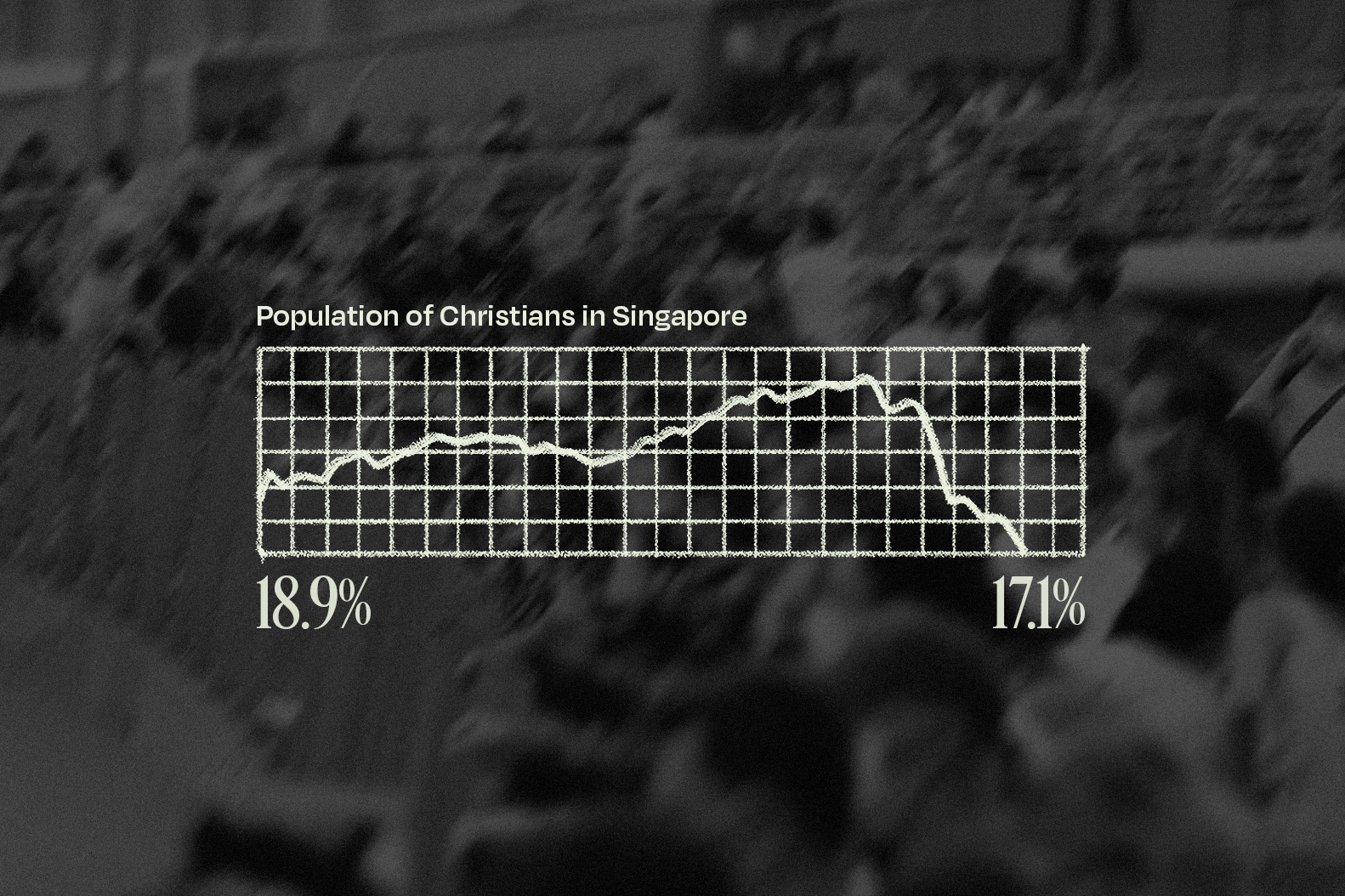
The latest General Household Survey 2025, released on June 30, revealed that the overall percentage of Christians (Protestants and Catholics combined) in Singapore, fell from 18.9% to 17.1%.
This fall of 1.8% marks the first recorded decline in Christianity’s share of Singapore’s resident population after four decades of uninterrupted growth. This alone gives us cause as the Body of God to grieve, reflect and to pray.
We have learned from the findings that Singapore is becoming less religious. Those with no religious affiliation rose from 24.2% to 26.8% among 15 to 24 year olds, and the same upward trend held across every age bracket in the survey, most sharply among those aged 35 to 44, up 6.7 percentage points to 29.0%, the highest share of any age group in 2025.
This suggests that both the young and the generation raising them are drifting from formal religious belonging at the same time.
So it’s worth naming a specific discipleship challenge we are facing here: the Church has to make a case for committed belonging in a generation increasingly comfortable holding nothing.
Counting the cost
Holding nothing costs nothing, which is why it appeals to a people who pride speed and efficiency.
Everyone knows someone who views church as a good-to-have when it’s convenient. We may even have been that person too in the past. Youth service? Good for morals and decent friends, but it can take a backseat in exam season.
If someone’s Christianity was mostly a set of good habits and good friends, then of course it competes on the same footing as every other good habit, CCA, tuition and loses when time is scarce. It was never seen as vital, because it was never framed as costly to begin with.
So the decline should not come as a shock if this is the kind of discipleship we have been perpetuating through multiple generations. If we’ve taught faith as an add-on to an already big life rather than a claim over the whole of it, we shouldn’t be surprised when a bigger life simply displaces it.
Luke 14:28 tells us about the builder who doesn’t count the cost before laying the foundation. Unfortunately, many in our congregations may have been building the same way. And a generation raised on faith as a matter of convenience and personal benefit is exactly what a foundation like that produces.
Programming, patience and authority
It’s worth reflecting on the programming of our ministries and what it actually produces.
Our events, worship nights, camps, courses… are these forming a disciple who carries his cross or an attendee who consumes Christian culture? Too often, the honest answer is the latter. Because it is so easy to become a consumer. We attend this church because the speaker is good. It’s nearer. The parking is easier. The worship team sounds nicer.
Without realising it, through the generations, we may have become more and more used to “better”, “easier”, “nicer”. But even the biggest, most put-together experience will never be a relationship with God. If we have come to serve experience and expediency, it naturally becomes easier to walk away when something no longer serves you, and something else attracts you.
The AI era we live in only accelerates this pattern. The magic of impossibly instantaneous and personalised answers from a screen lowers our tolerance for the waiting, friction and submission that discipleship under human leadership requires.
In the church context, answers to the deeper things of life that we worry about, like relationships and the future, used to require going to someone. That person would probably be your pastor or small group leader. That meant relationship, scheduling a meal together, waiting, and sometimes a rebuke that came after. But now, answers can come immediately, frictionlessly and with no accountability attached. And that’s without even getting into whether they are accurate and aligned with the Word of God.
If we are not careful, we may have already been bent into a posture that prizes knowledge over wisdom. Without discernment and restraint, AI can accelerate a pattern that consumer culture has already trained in us: I get what’s good for me with no obligation to anyone. But spiritual leadership asks for the opposite: coming under, being known, being correctable.
Which do we really want?
Who we were meant to be
17.1% can make for a scary picture of churches heading toward irrelevance and children growing up without Christ. The statistic does show us that Christianity is becoming less mainstream here, but there is still reason for hope.
What if this shift, this wake-up call, is God’s way of bringing us back to who we were always meant to be?
We are a chosen people, a royal priesthood (1 Peter 2:9-12), sojourners and exiles, told to live lives of goodness and good deeds so that unbelievers cannot help but to see God and glorify Him.
Consider also that the early Church was a minority church scattered through a majority-pagan empire. They were not a church desperately trying to claw their way back to majority status or maintain it, but a spiritual community that never had it and whose main mission was to shine Jesus’s light and make disciples.
“You are the salt of the earth. But if the salt loses its saltiness, how can it be made salty again? It is no longer good for anything, except to be thrown out and trampled underfoot.
“You are the light of the world. A town built on a hill cannot be hidden. Neither do people light a lamp and put it under a bowl. Instead they put it on its stand, and it gives light to everyone in the house. In the same way, let your light shine before others, that they may see your good deeds and glorify your Father in heaven.” (Matthew 5:13-16)
Salt that tastes like everything else is worthless. Light that does not illuminate the darkness is worthless.
Drawing Kingdom contrasts against the world, by actually living out the Word of God, must again become a defining characteristic of our spiritual communities.
For many of us, divine distinctions are why we first stepped foot into a church or stayed. It’s different here. We need to help others experience Jesus similarly in our programming, our outreach, our loving and most of all our living.
When we again learn what it means to be truly set apart for God, and shine like a city on a hill, that is when true revival will spring forth.
It’s not a numbers game
Irrelevance is not a threat, it is a choice. If we are shrinking, then let it be a distillation towards clarity.
- The Church is ministering in an increasingly secular Singapore.
- The Church has to make a case for committed belonging in a generation increasingly comfortable holding nothing.
- The Church has to be set apart to shine.
Now is the time to pray. When God speaks, we must hear what it is He wants us to do amidst this spiritual landscape.
We must be willing enough to change our plans and our ways, and to realign ourselves to what He wants, doing things His way. We must be humble enough to see our own nation as our mission field. We must be hungry enough to be set apart.
Now is the time to be bold. Statistics don’t determine the future of the Kingdom; God determines the future of His Kingdom.
Consider Gideon’s 300 soldiers, Jehoshaphat’s worshipping vanguard or how God always leaves a remnant. If God is in us and for us, the odds don’t matter.
But we must be willing to trust Him. We must be willing to wage spiritual war. We must not be afraid of being pressed in and surrounded. We must be willing to die, to ourselves and for the Gospel.
That is, after all, how the heroes of the faith shined for God. It is how we must do so likewise.

- Where in my own life, or in how I disciple others, has faith been framed as a good-to-have rather than a claim on the whole of life? What would it look like to name that cost honestly instead of avoiding it?
- Am I forming disciples who carry their cross, or attendees who consume Christian culture? What does my church, small group, or family actually train people to expect from following Jesus?
- If the Church is called to be salt and light rather than the majority, what would it mean for my own community to be genuinely distinct, not louder or bigger, but visibly different in how we love, live and give?