My curiosity surrounding theological differences first arose when I watched my church friends engage in a heated debate over the gifts of tongues and prophecy.
One friend argued that these gifts no longer apply today, while another believed they remain active manifestations of the Holy Spirit.
After a back-and-forth discussion, they couldn’t find common ground, and the conversation came to an awkward standstill…
A key part of growing in the Christian faith is developing a deeper commitment to certain expressions of the faith. However, things can become tricky when these commitments don’t quite align with those of our brothers and sisters-in-Christ.
And yet these moments of divergence also hold unique growth potential, both in our friendships and spiritual maturity.
If you find yourself or your friends stuck in a theological disagreement, here are some guiding principles you can use to navigate these discussions with grace and love.
Is it a primary or secondary belief?
The first step in dealing with theological disagreements is to determine if the issue is a primary or secondary belief.
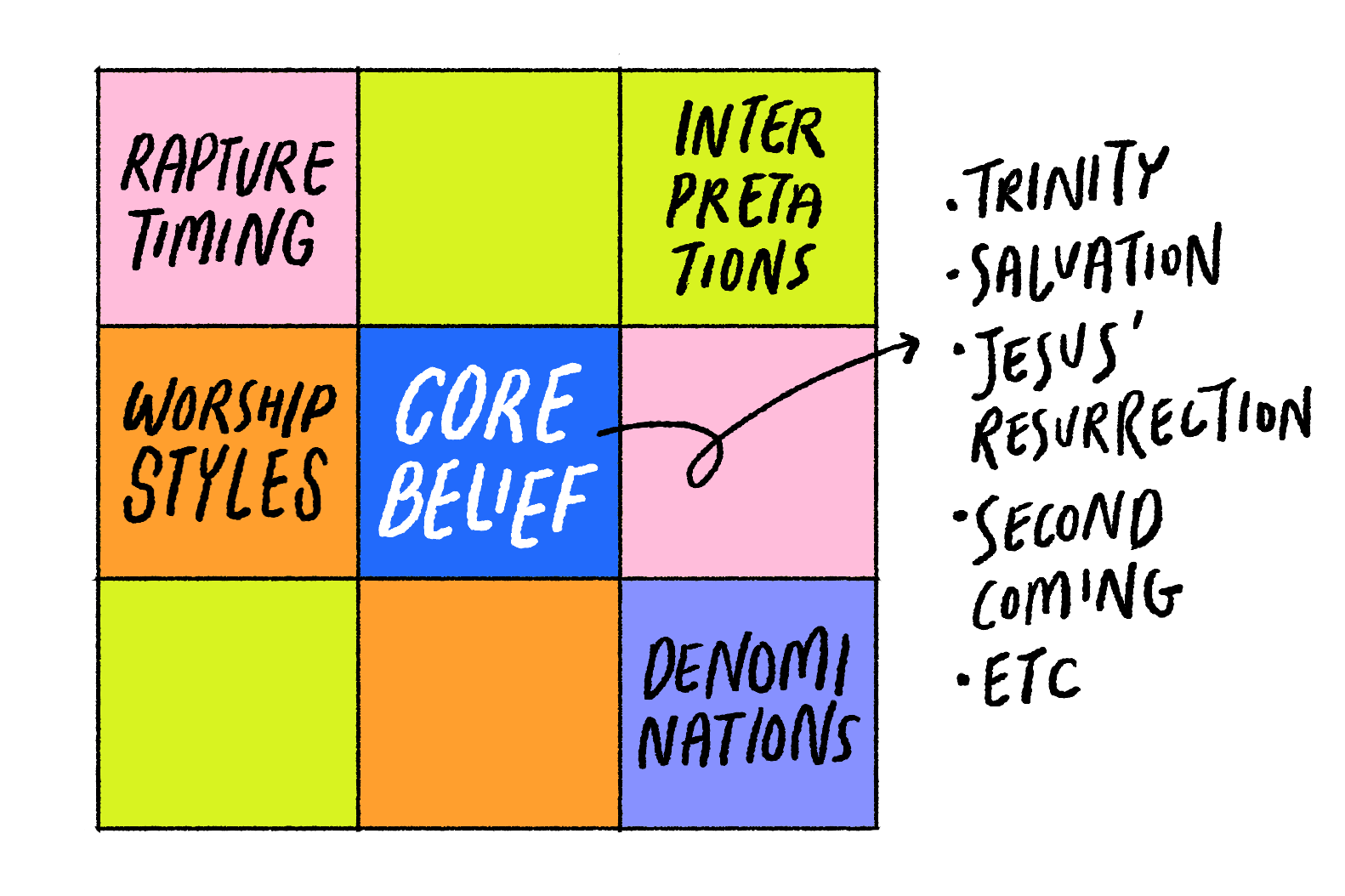
Primary beliefs are foundational to the Christian faith and are non-negotiable. These would be core doctrines like the Trinity, salvation by faith, and Christ’s atonement, resurrection and return.
When it comes to primary beliefs, we must stand firm as they concern the heart of the Gospel.
Secondary beliefs, on the other hand, are interpretations and understandings that might differ from denomination to denomination or person to person. These can include views on baptism, styles of worship or specific end-times interpretations.
If we dig deeper, we may find that many of these secondary beliefs are traditions or simply preferences. While these may be significant to many within the Christian community, they are not the Gospel and hence should not disrupt the unity we share in Christ.
Recognising that there are different expressions in Christianity allows for respectful dialogue and encourages a spirit of unity and learning from one another’s perspectives.
Utilise the right resources
When exploring theological questions, it is essential to ground your discussions in Scripture and seek resources that offer reliable guidance.
Psalms 119:105 reminds us that God’s Word is a lamp to our feet and a light for our path. Scripture should serve as our guiding compass, providing clarity and discernment as we navigate complex issues.
It is particularly essential as we seek to unravel theological questions, offering a firm foundation of truth upon which to base our understanding.
Moreover, seeking guidance from trusted mentors, pastors or church leaders can offer valuable perspective and insight into complex matters.
They can act as mediators, helping to clarify misunderstandings and direct the dialogue toward fostering unity rather than division.
Prayer, too, is a valuable tool in these circumstances. Inviting God into such conversations helps to set the tone, soften hearts and cultivate an atmosphere of peace.
Consider beginning or concluding these discussions with prayer, petitioning for wisdom, humility and a spirit of unity, as outlined in Philippians 2:1-2:
Therefore if you have any encouragement from being united with Christ, if any comfort from his love, if any common sharing in the Spirit, if any tenderness and compassion, then make my joy complete by being like-minded, having the same love, being one in spirit and of one mind. (Philippians 2:1-2)
In this passage, Paul emphasises that true unity within the Christian community goes beyond mere agreement. It is rooted in a shared love for Christ, a common purpose, and a deep compassion for one another.
Being “one in spirit and of one mind” means putting aside personal differences for the sake of unity in Christ and the greater mission of sharing His love with others.
By inviting God’s presence intentionally, we are reminded that these conversations are ultimately about drawing nearer to Him and aligning our hearts with His will.
Practise patience and humility
Ultimately, the goal of any theological discussion should never be to “win” or to be “right”, but to reflect Christ’s love and humility and glorify God through our conversation.
In Ephesians 4:2, the Apostle Paul reminds us to “be completely humble and gentle; be patient, bearing with one another in love.”
We can stand firm in our beliefs while approaching discussions with gentleness and respect, prioritising the relationship over the need to win an argument.
This involves acknowledging and striving to understand the other person’s perspective, even when we may not agree. After thoroughly listening to their point of view, we can patiently share our own, thoughtfully explaining the reasons behind our beliefs.
Even when differences arise over primary beliefs, we must engage with caution, showing grace and avoiding belittling the other person’s perspective.
Jesus modelled this perfectly in His encounters with others. He met people where they were, gently guiding them toward the truth, patiently answering questions, and challenging beliefs without condemnation.
When we engage with others in love and humility, we nurture our relationships and reflect Christ’s love, offering a living example of His grace in action.
Trust God to use these differences for His good
Such diversity within the Christian community is a blessing. God created each of us uniquely, with different backgrounds, cultures and ways of understanding the world.
By embracing diverse perspectives, we can learn more about God’s multifaceted nature and broaden our understanding of faith.
Romans 12:4-5 emphasises the value of diversity and unity within the Body of Christ: “For just as each of us has one body with many members, and these members do not all have the same function, so in Christ we, though many, form one body, and each member belongs to all the others.”
While we are all different, each of us plays a unique and essential role within the larger Body of Christ. Our differences are not to be seen as obstacles but as opportunities for growth and deeper understanding.
Secondary theological differences, though sometimes tricky to navigate, are a vital part of the Church’s growth. They invite us to explore deeper questions and to wrestle with Scripture in ways that sharpen our faith.
In such situations, we can trust that God will use our differences for His good, drawing us closer to Him and one another.
If you find yourself in a situation where friends hold differing theological views on secondary matters, take a step back to consider whether the discussion is building understanding or leading to division.
Always bear in mind that we are meant to uphold unity in Christ while respecting diverse perspectives. Approach the conversation humbly, seek wise resources and trust that God can use these differences for His divine purposes!
DO YOU ENJOY READING THIR.ST?
This year, as we celebrate 10 years, consider sowing into our Kingdom ministry! For S$10 a month, you become part of the #10for10 community and a part of every story we tell.
PARTNER WITH US

Glenda Foo
Glenda is a huge foodie and has a particular obsession with Korean stews. If she's not eating, she's most likely playing badminton or watching the latest K-drama in bed.