I came to the Conference this morning by no means as a mental health expert. Instead, I’m a witness of what happens when you neglect one’s own inner life. I’m a witness to the grace of God when we finally stop pretending and dropping our masks.
Seven years ago, at the age of 27, I became lead pastor of my church, The City. Now, there are many talented 27-year-olds in the world. I didn’t think I was one of them, and so I stepped into this role with a great deal of godly conviction, but also, to be honest, with a deep desire to prove myself.
everything looked really good…. the sermons were decent and the church was growing — and that absolutely frightened me. Because I realised that you can be a good and successful pastor but still be a spiritual wreck on the inside.
Therefore, in my first year of pastoring, I simply buried myself in work and ministry, packing my days full of meetings, and staying up to work late in the night. Even when I was not working, I was always thinking about work.
This caused me to constantly live with a low grade of anxiety, but it was just something I accepted as normal.
In that period, I slept an average of three hours every night, ate at ungodly hours, and was sedentary, essentially leading a very unsustainable lifestyle. I was spiritually busy, but also completely worn out.
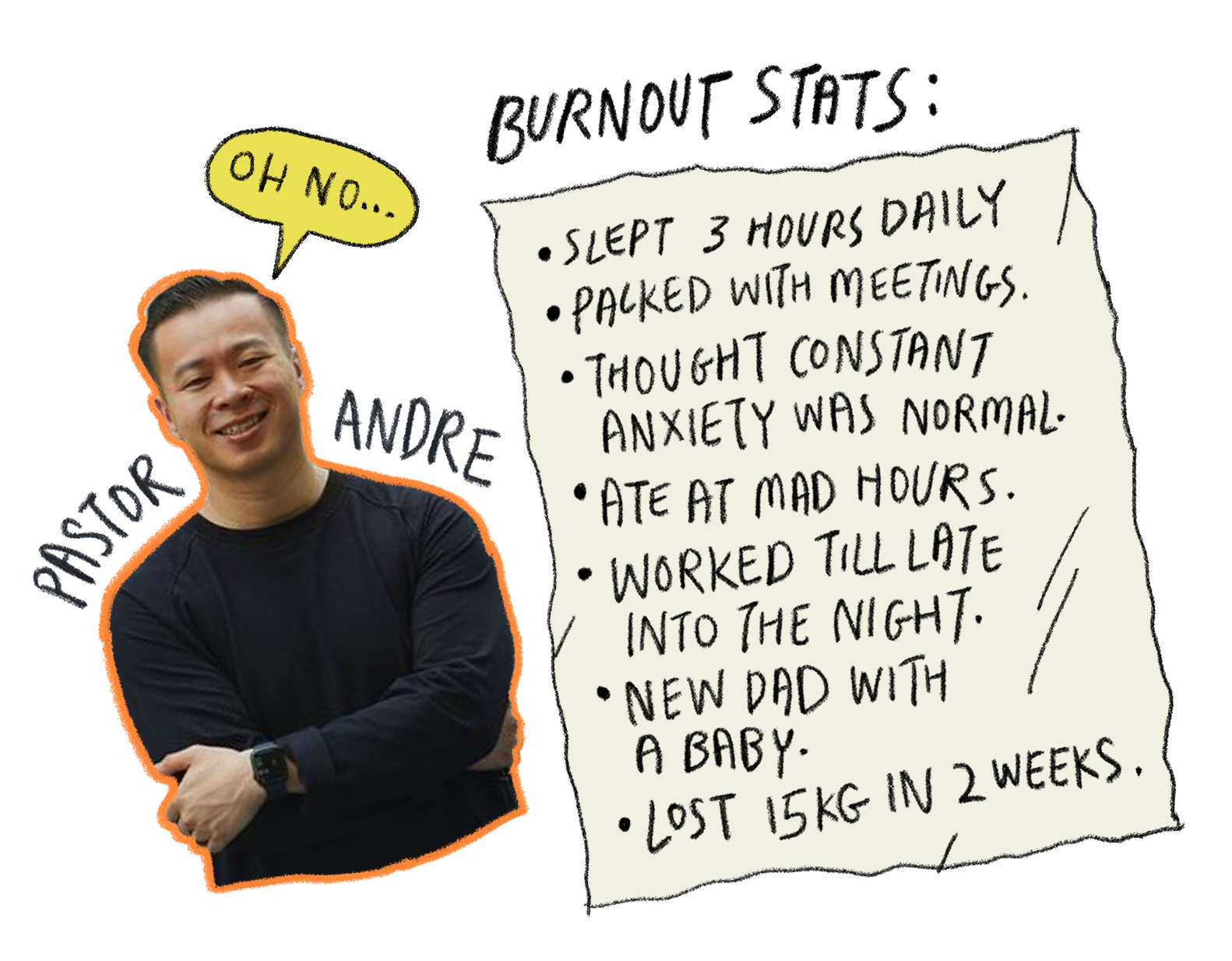
About six months into this new role, the effects of this lifestyle soon began to catch up to me. I lost 15kg in a span of two weeks.
The funny thing was, I even thought the weight loss was God’s supernatural gift to me at one point. It felt like I could do whatever I wanted to do to my body, while still managing to lose weight.
However, my friends clearly didn’t think so. A few of them got really concerned, and so I decided to go for a full body check-up, though I expected everything to come back normal.
A few days later, on a Sunday, right after preaching a sermon at church, my wife told me that the doctor had called, asking me to go to the hospital immediately. There, I was told that the blood work had shown that I was at risk of a stroke.
The next day felt like the darkest Monday of my life.
27 — and at risk of stroke
I was going hard for God, doing all the right things, serving Him, being faithful to do the Kingdom’s work… yet here I was diagnosed with a chronic condition, issued with a whole bunch of medication, all at the age of 27.
This was not meant to be happening. Growing up hearing things like “you don’t burn out, you burn on” and “as long as you stay close to God, you keep going”, it felt like all the schemas I built up in my head about God, about ministry, about faith, all came crumbling down in a single day.
It really felt like I was living in perpetual darkness. And all day long, I wrestled with the thought of ending my own life that day, even though I was the lead pastor of a church six months in, with a baby in tow.
I was tired, I was scared, and I felt so much shame. I remember thinking, “Who could I talk to about this? What if people found out that I was actually struggling? Would I get fired?”
Instead of processing my grief and pain, I tried to move past it as quickly as possible. Two weeks later, I was back in church preaching, as though nothing had ever happened.
Additionally, everything looked really good from the outside. The sermons were decent and the church was growing — and that absolutely frightened me.
Because I realised that you can be a “good” and “successful” pastor but still be a spiritual wreck on the inside.
We confuse reputation with reality, curate a persona rather than cultivate our souls, perform aliveness — but are actually dead!
I think of the words of Jesus to the church in Sardis, in the book of Revelation.
He saw through all of the activity and the appearance, and saw the heart. And Jesus said, you have a reputation of being alive but you are, in fact, dead.
And that’s the chilling part, isn’t it? We confuse reputation with reality, curate a persona rather than cultivate our souls, perform aliveness — but are actually dead!
3 principles for real rest
While that was a difficult season for me, there are three sobering truths I’ve learned:
1. We are not machines
We are souls. Our bodies may be able to keep going for a while under pressure, but our souls will eventually show the cost.
We weren’t designed to function like programmes running on adrenaline and performance while we neglect our inner life. Often the body ends up expressing what the soul has been holding for far too long, and that was my case.
2. The life Jesus invites us to, moves at a different pace from our culture
At the heart of Jesus’ invitation in John 15 is the word “abide”, which means to remain, dwell and stay close. However, it can almost feel unnatural in our world and in our day.
Yet it is also this pace where real formation happens. Jesus is not impressed with how fast we go for him. He instead calls us to remain in Him.

3. Rest is not weakness
Instead, rest is resistance. It’s resistance against a culture that measures our worth by output and a rebellion against the tyranny of never enough.
Rest is stewardship, because a whole and healthy you is the best gift you can give to your family, your friends, your church and your organisation.
We live in a world that rewards performance and punishes weakness, but the Kingdom of God is different.
Instead, blessed are the poor in spirit. Blessed are those who mourn. Blessed are those who confess, who stop pretending, who dare to slow down, and who dare to be human.
Therefore, perhaps healing begins not with doing more or trying to be more, but finally telling the truth that you’re not okay — and that’s okay.